Tech Kaizen

passion + usefulness = success .. change is the only constant in life

Search this Blog:

Showing posts with label EDGE COMPUTING. Show all posts

FIDO Device Onboard (FDO)

FIDO Device Onboard (FDO), sometimes called 'device provisioning,' is a Specification for Automated, Secure IoT Provisioning Technology leveraging asymmetric public key cryptography to provide the industrial IoT industry with a fast and secure way to onboard any device to any device management system.

What is "Device Onboarding"?
Device onboarding is the process of installing secrets and configuration data into a device, so it can connect and interact securely with an IoT platform. An IoT platform could range from an application on a user’s computer, phone or tablet, to an enterprise server, to a cloud service spanning multiple geographic regions. The device owner uses the IoT platform to manage the device by patching security vulnerabilities, installing or updating software, retrieving sensor data, interacting with actuators, and more.

FDO is invoked autonomously and performs only limited, specific, interactions with its environment to complete. A unique feature of FDO is the ability for the device owner to select the IoT platform at a late stage in the device life cycle. The secrets or configuration data may also be created or chosen at this late stage, with a feature called “late binding”.

ref:

1. https://fidoalliance.org/intro-to-fido-device-onboard

2. FIDO Device Onboard Specification - https://fidoalliance.org/specs/FDO/FIDO-Device-Onboard-RD-v1.0-20201202.html

3. https://www.embedded.com/fido-device-onboarding-integrated-into-iot-identity-access-management/

4. https://www.redalertlabs.com/blog/top-10-things-you-should-know-about-fido-device-onboarding-fdo

Posted by Krishna Kishore Koney
Labels: CLOUD COMPUTING, EDGE COMPUTING

Secure Access Service Edge(SASE)

Secure Access Service Edge, also known as SASE -- pronounced "sassy" is a cloud architecture model that bundles network and security-as-a-service functions together and delivers them as a single cloud service. A SASE approach offers better control over and visibility into the users, traffic, and data accessing a corporate network - vital capabilities for modern, globally distributed organizations. Networks built with SASE are flexible and scalable, able to connect globally distributed employees and offices across any location and via any device.

A SASE architecture combines a software-defined wide area network (SD-WAN) or other WAN with multiple security capabilities (e.g., cloud access security brokers, anti-malware), securing your network traffic as the sum of those functions. SASE provides a simple security and networking tool that is independent of where employees and resources are located. SASE requires little to no hardware, using the widespread connectivity of cloud technology to combine SD-WAN with network security functions, including:

  • firewall as a service (FWaaS)
  • software as a service (SaaS)
  • secure web gateways (SWG)
  • cloud access security broker (CASB)
  • zero-trust network access (ZTNA)

How does SASE compare to traditional networking?
In a traditional network model, data and applications live in a core data center. In order to access those resources, users, branch offices, and applications connect to the data center from within a localized private network or a secondary network that typically connects to the primary one through a secure leased line or VPN. Due to the rise of distributed workforces, It is no longer practical to reroute all traffic through a centralized data center if applications and data are hosted in the cloud.

By contrast, SASE places network controls on the cloud edge — not the corporate data center. Instead of layering cloud services that require separate configuration and management, SASE streamlines network and security services to create a secure network edge. Implementing identity-based, Zero Trust access policies on the edge network allows enterprises to expand their network perimeter to any remote user, branch office, device, or application.

ref:

1. https://www.cloudflare.com/learning/access-management/what-is-sase/

2. https://www.techtarget.com/searchnetworking/definition/Secure-Access-Service-Edge-SASE

3. https://www.zscaler.com/resources/security-terms-glossary/what-is-sase

Posted by Krishna Kishore Koney
Labels: CLOUD COMPUTING, CYBERSECURITY, EDGE COMPUTING

The Lightweight Kubernetes Distribution Built for the Edge - k3s

K3s is a lightweight, easy to install Kubernetes distribution geared towards resource-constrained environments and low touch operations. Some use cases in which k3s really shines are edge, ARM, IoT, and CI. 

K3s from Rancher Labs is packaged as a single binary which is about 40 megabytes in size. Bundled in that single binary is everything needed to run Kubernetes, including the container runtime and any important host utilities like iptables, socat, and du. The only OS dependencies are the Linux kernel itself and a proper dev, proc, and sysfs mounts (this is done automatically on all modern distros). Cloud Native Computing Foundation (CNCF) has accepted the K3s as its Sandbox project in Aug'2020. 

What is K3s?:
K3s is a fully compliant Kubernetes distribution with the following enhancements:

  1. Packaged as a single binary.
  2. Lightweight storage backend based on sqlite3 as the default storage mechanism. etcd3, MySQL, Postgres also still available.
  3. Wrapped in simple launcher that handles a lot of the complexity of TLS and options.
  4. Secure by default with reasonable defaults for lightweight environments.
  5. Simple but powerful “batteries-included” features have been added, such as: a local storage provider, a service load balancer, a Helm controller, and the Traefik ingress controller.
  6. Operation of all Kubernetes control plane components is encapsulated in a single binary and process. This allows K3s to automate and manage complex cluster operations like distributing certificates.
  7. External dependencies have been minimized (just a modern kernel and cgroup mounts needed). K3s packages required dependencies, including:
  1. Containerd
  2. Flannel
  3. CoreDNS
  4. CNI
  5. Host utilities (iptables, socat, etc)
  6. Ingress controller (traefik)
  7. Embedded service loadbalancer
  8. Embedded network policy controller

ref: 

K3s, Lightweight Kubernetes - https://rancher.com/docs/k3s/latest/en/, https://www.infoworld.com/article/3342125/rancher-k3s-brings-kubernetes-to-iot-devices.html

K3s Architecture - https://rancher.com/docs/k3s/latest/en/architecture/

K3s github source code - https://github.com/rancher/k3s

K3s overview - https://rancher.com/blog/2019/2019-02-26-introducing-k3s-the-lightweight-kubernetes-distribution-built-for-the-edge/ 

Build a Kubernetes cluster using k3s via Ansible - https://github.com/rancher/k3s-ansible

Develop your cloud native use cases at the edge with K3s - https://www.cncf.io/webinars/develop-your-cloud-native-use-cases-at-the-edge-with-k3s/

Rancher Labs’ K3s Joins Cloud Native Computing Foundation as Sandbox Project - https://www.businesswire.com/news/home/20200826005093/en/Rancher-Labs%E2%80%99-K3s-Joins-Cloud-Native-Computing


Posted by Krishna Kishore Koney
Labels: CLOUD COMPUTING, EDGE COMPUTING, KUBERNETES

Open Network Automation Platform (ONAP)

Open Network Automation Platform (ONAP) project addresses the rising need for a common automation platform for telecommunication, cable, and cloud service providers and their solution providers that enables the automation of different lifecycle processes, to deliver differentiated network services on demand, profitably and competitively, while leveraging existing investments. It is an open source software platform that delivers robust capabilities for the design, creation, orchestration, monitoring, and life cycle management of Network Function Virtualization (NFV) environments, as well as Software-Defined Networks (SDN).

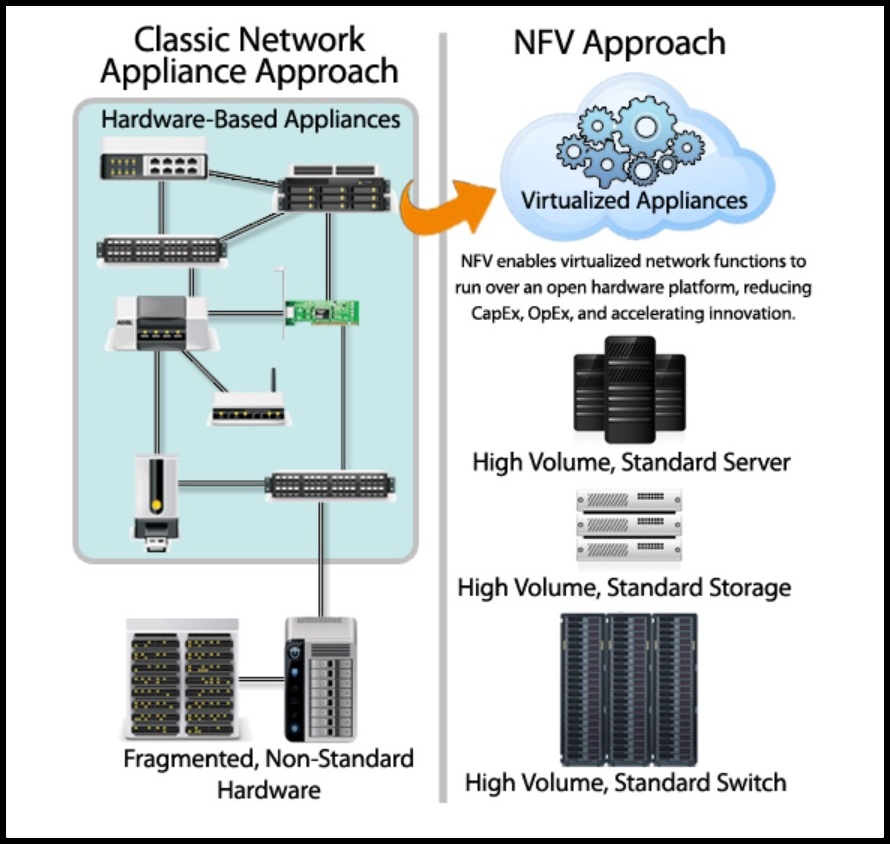
Network Functions Virtualization (NFV) allows network operators to reduce their dependence on single-purpose appliances by taking functions that were previously built into hardware and implementing them in software that runs on industry-standard servers, network, and storage platforms. Beyond reducing network operators’ dependency on dedicated hardware, leveraging NFV enables more programmability in the network and greatly reduces the complexity and time-to-market associated with introducing new services.

Network Function Virtualization(NFV) is a way to reduce cost and accelerate service deployment for network operators by decoupling functions like a firewall or encryption from dedicated hardware and moving them to virtual servers. Instead of installing expensive proprietary hardware, service providers can purchase inexpensive switches, storage and servers to run virtual machines that perform network functions.  This collapses multiple functions into a single physical server, reducing costs and minimizing truck rolls. If a customer wants to add a new network function, the service provider can simply spin up a new virtual machine to perform that function. For example, instead of deploying a new hardware appliance across the network to enable network encryption, encryption software can be deployed on a standardized server or switch already in the network.

Software Defined Networking(SDN) technology is an approach to network management that enables dynamic, programmatically efficient network configuration in order to improve network performance and monitoring, making it more like cloud computing than traditional network management. 

SDN vs NFV:

Network Functions Virtualization is highly complementary to Software-Defined Networking (SDN) but not dependent on it (or vice-versa). Network Functions Virtualization can be implemented without an SDN being required, although the two concepts and solutions can be combined and potentially greater value accrued.

Network Functions Virtualization goals can be achieved using non-SDN mechanisms, relying on the techniques currently in use in many data centers. But approaches relying on the separation of the control and data forwarding planes as proposed by SDN can enhance performance, simplify compatibility with existing deployments, and facilitate operation and maintenance procedures. NFV is able to support SDN by providing the infrastructure upon which the SDN software can be run. Furthermore, Network Functions Virtualization aligns closely with the SDN objectives to use commodity servers and switches.


ref:

ONAP -  https://www.onap.org/

ONAP wiki - https://wiki.onap.org/
 
ONAP Glossary(NFV, SDN resources) - https://wiki.onap.org/display/DW/Glossary
 
ONAP Projects - https://wiki.onap.org/display/DW/ONAP+Projects
 
The Edge Multi Cloud Orchestrator(EMCO) Architecture & Design - https://wiki.onap.org/pages/viewpage.action?pageId=84668166 
 
ONAP github source code - https://github.com/onap

ONAP multicloud-k8s github source code - https://github.com/onap/multicloud-k8s
 
ONAP gerrit - https://gerrit.onap.org/r/q/status:open
 
ONAP SDN - https://wiki.onap.org/display/DW/SDN-R
 
NFV(Network Function Virtualization) - https://en.wikipedia.org/wiki/Network_function_virtualization
 
ETSI NFV -
     https://www.etsi.org/technologies/nfv
 
     https://www.etsi.org/technologies/689-network-functions-virtualisation
 
OPNFV - https://www.opnfv.org/ 
 
ONAP documentation - https://docs.onap.org/en/frankfurt/

ONAP overview - https://docs.onap.org/en/frankfurt/guides/overview/overview.html
 
ONAP v2 High level Architecture - https://wiki.onap.org/download/attachments/1015842/arch3_207.png?version=1&modificationDate=1486486468000&api=v2
 
Communications Service Provider(CoSP) aka 5g Cloud -
    https://www.intel.sg/content/dam/www/public/us/en/documents/white-papers/cosp-cloud-white-paper.pdf

    https://blog.equinix.com/blog/2018/07/17/the-role-of-5g-networking-and-cloud/

NFV Microservices - https://blog.mellanox.com/2017/06/the-ideal-network-for-containers-and-nfv-microservices/

Cloud Native Edge App & NFV Stack(Srinivasa Addepalli) - https://events19.linuxfoundation.org/wp-content/uploads/2018/07/ONS2019_Cloud_Native_NFV.pdf
 
Misc =>

https://www.cisco.com/c/en/us/solutions/software-defined-networking/sdn-vs-nfv.html

https://www.blueplanet.com/resources/What-is-NFV-prx.html

https://wiki.opnfv.org/display/PROJ/OPNFV-ONAP

https://www.onap.org/tag/opnfv

https://www.opnfv.org/blog/2019/03/07/what-i-learned-at-the-onap-opnfv-event-in-paris-saclay

Posted by Krishna Kishore Koney
Labels: CLOUD COMPUTING, EDGE COMPUTING, KUBERNETES
Older Posts Home
Subscribe to: Posts (Atom)

The Verge - YOUTUBE

Loading...

Hard Fork Podcast

Loading...

Dwarkesh Patel Podcast

Loading...

SemiAnalysis Podcast (Dylan Patel)

Loading...

Andrej Karpathy Youtube Channel

Loading...

Microsoft Research

Loading...

Hugging Face - Blog

Loading...

AI at Wharton

Loading...

Stanford Online

Loading...

MIT OpenCourseWare - YOUTUBE

Loading...

NPTEL IISC BANGALORE - YOUTUBE

Loading...

HackerRank - YOUTUBE

Loading...

FREE CODE CAMP - YOUTUBE

Loading...

BYTE BYTE GO - YOUTBUE

Loading...

GAURAV SEN INTERVIEWS - YOUTUBE

Loading...

Tanay Pratap - YOUTUBE

Loading...

Ashish Pratap Singh - YOUTUBE

Loading...

Kantan Coding - YOUTUBE

Loading...

SUCCESS IN TECH INTERVIEWS - YOUTUBE

Loading...

IGotAnOffer: Engineering - YOUTUBE

Loading...

DEEPLEARNING AI - YOUTUBE

Loading...

MIT News - Artificial intelligence

Loading...
My photo
Krishna Kishore Koney
View my complete profile
" It is not the strongest of the species that survives nor the most intelligent that survives, It is the one that is the most adaptable to change "

View krishna kishore koney's profile on LinkedIn


Failure is not falling down, it is not getting up again. Success is the ability to go from failure to failure without losing your enthusiasm.

Where there's a Will, there's a Way. Keep on doing what fear you, that is the quickest and surest way to to conquer it.

Vision is the art of seeing what is invisible to others. For success, attitude is equally as important as ability.

Monthly Blog Archives

  • ▼  2026 (7)
    • ▼  July (2)
      • REST vs GraphQL
      • Nautobot: Opensource Network Source of Truth (NSoT...
    • ►  May (1)
    • ►  April (1)
    • ►  March (3)
  • ►  2025 (4)
    • ►  October (1)
    • ►  August (1)
    • ►  May (1)
    • ►  April (1)
  • ►  2024 (18)
    • ►  December (1)
    • ►  October (2)
    • ►  September (5)
    • ►  August (10)
  • ►  2022 (2)
    • ►  December (2)
  • ►  2021 (2)
    • ►  April (2)
  • ►  2020 (18)
    • ►  November (1)
    • ►  September (8)
    • ►  August (1)
    • ►  June (8)
  • ►  2019 (18)
    • ►  December (1)
    • ►  November (2)
    • ►  September (3)
    • ►  May (8)
    • ►  February (1)
    • ►  January (3)
  • ►  2018 (3)
    • ►  November (1)
    • ►  October (1)
    • ►  January (1)
  • ►  2017 (2)
    • ►  November (1)
    • ►  March (1)
  • ►  2016 (5)
    • ►  December (1)
    • ►  April (3)
    • ►  February (1)
  • ►  2015 (15)
    • ►  December (1)
    • ►  October (1)
    • ►  August (2)
    • ►  July (4)
    • ►  June (2)
    • ►  May (3)
    • ►  January (2)
  • ►  2014 (13)
    • ►  December (1)
    • ►  November (2)
    • ►  October (4)
    • ►  August (5)
    • ►  January (1)
  • ►  2013 (5)
    • ►  September (2)
    • ►  May (1)
    • ►  February (1)
    • ►  January (1)
  • ►  2012 (19)
    • ►  November (1)
    • ►  October (2)
    • ►  September (1)
    • ►  July (1)
    • ►  June (6)
    • ►  May (1)
    • ►  April (2)
    • ►  February (3)
    • ►  January (2)
  • ►  2011 (20)
    • ►  December (5)
    • ►  August (2)
    • ►  June (6)
    • ►  May (4)
    • ►  April (2)
    • ►  January (1)
  • ►  2010 (41)
    • ►  December (2)
    • ►  November (1)
    • ►  September (5)
    • ►  August (2)
    • ►  July (1)
    • ►  June (1)
    • ►  May (8)
    • ►  April (2)
    • ►  March (3)
    • ►  February (5)
    • ►  January (11)
  • ►  2009 (113)
    • ►  December (2)
    • ►  November (5)
    • ►  October (11)
    • ►  September (1)
    • ►  August (14)
    • ►  July (5)
    • ►  June (10)
    • ►  May (4)
    • ►  April (7)
    • ►  March (11)
    • ►  February (15)
    • ►  January (28)
  • ►  2008 (61)
    • ►  December (7)
    • ►  September (6)
    • ►  August (1)
    • ►  July (17)
    • ►  June (6)
    • ►  May (24)
  • ►  2006 (7)
    • ►  October (7)

Blog Archives Categories

  • .NET DEVELOPMENT (38)
  • 5G (5)
  • AI (Artificial Intelligence) (16)
  • AI/ML (10)
  • ANDROID DEVELOPMENT (7)
  • BIG DATA ANALYTICS (6)
  • C PROGRAMMING (7)
  • C++ PROGRAMMING (24)
  • CAREER MANAGEMENT (6)
  • CHROME DEVELOPMENT (2)
  • CLOUD COMPUTING (47)
  • CODE REVIEWS (3)
  • CYBERSECURITY (12)
  • DATA SCIENCE (4)
  • DATABASE (14)
  • DESIGN PATTERNS (9)
  • DEVICE DRIVERS (5)
  • DIY (3)
  • DOMAIN KNOWLEDGE (14)
  • EDGE COMPUTING (4)
  • EMBEDDED SYSTEMS (9)
  • ENTERPRISE ARCHITECTURE (10)
  • IMAGE PROCESSING (3)
  • INTERNET OF THINGS (2)
  • J2EE PROGRAMMING (10)
  • KERNEL DEVELOPMENT (6)
  • KUBERNETES (20)
  • LATEST TECHNOLOGY (25)
  • LINUX (9)
  • MAC OPERATING SYSTEM (2)
  • MOBILE APPLICATION DEVELOPMENT (14)
  • PORTING (4)
  • PYTHON PROGRAMMING (6)
  • RESEARCH AND DEVELOPMENT (1)
  • SCRIPTING LANGUAGES (8)
  • SERVICE ORIENTED ARCHITECTURE (SOA) (10)
  • SOFTWARE DESIGN (13)
  • SOFTWARE QUALITY (5)
  • SOFTWARE SECURITY (24)
  • SYSTEM and NETWORK ADMINISTRATION (4)
  • SYSTEM PROGRAMMING (4)
  • TECHNICAL MISCELLANEOUS (32)
  • TECHNOLOGY INTEGRATION (5)
  • TEST AUTOMATION (5)
  • UNIX OPERATING SYSTEM (4)
  • VC++ PROGRAMMING (44)
  • VIRTUALIZATION (8)
  • WEB PROGRAMMING (8)
  • WINDOWS OPERATING SYSTEM (13)
  • WIRELESS DEVELOPMENT (5)
  • XML (3)

Popular Posts

  • Windows FileSystem Mini Filter Driver Development
  • Windows Shutdown Messages/Events : WM_QUERYENDSESSION, WM_ENDSESSION
  • Nautobot: Opensource Network Source of Truth (NSoT) and Network Automation Platform
  • Windows User-Mode Driver Framework (UMDF) ..

My Other Blogs/Channels

  • Career Management: Invest in Yourself
  • A la carte: Color your Career
  • Attitude is everything(Telugu language)
  • "Invest in Yourself" Youtube Channel (Telugu language)
WINNING vs LOSING

Hanging on, persevering, WINNING
Letting go, giving up easily, LOSING

Accepting responsibility for your actions, WINNING
Always having an excuse for your actions, LOSING

Taking the initiative, WINNING
Waiting to be told what to do, LOSING

Knowing what you want and setting goals to achieve it, WINNING
Wishing for things, but taking no action, LOSING

Seeing the big picture, and setting your goals accordingly, WINNING
Seeing only where you are today, LOSING

Being determined, unwilling to give up WINNING
Gives up easily, LOSING

Having focus, staying on track, WINNING
Allowing minor distractions to side track them, LOSING

Having a positive attitude, WINNING
having a "poor me" attitude, LOSING

Adopt a WINNING attitude!

Total Pageviews

Who am I

My photo
Krishna Kishore Koney

Blogging is about ideas, self-discovery, and growth. This is a small effort to grow outside my comfort zone.

Most important , A Special Thanks to my parents(Sri Ramachandra Rao & Srimathi Nagamani), my wife(Roja), my lovely daughter (Hansini) and son (Harshil) for their inspiration and continuous support in developing this Blog.

... "Things will never be the same again. An old dream is dead and a new one is being born, as a flower that pushes through the solid earth. A new vision is coming into being and a greater consciousness is being unfolded" ... from Jiddu Krishnamurti's Teachings.

Now on disclaimer :
1. Please note that my blog posts reflect my perception of the subject matter and do not reflect the perception of my Employer.

2. Most of the times the content of the blog post is aggregated from Internet articles and other blogs which inspired me. Due respect is given by mentioning the referenced URLs below each post.

Have a great time

My LinkedIn Profile
View my complete profile

Aryaka Insights

Loading...

Reid Hoffman - YOUTUBE

Loading...

Martin Fowler's Bliki - BLOG

Loading...

The Pragmatic Engineer

Loading...

AI Workshop

Loading...

CYBER SECURITY - YOUTUBE

Loading...

CYBER SECURITY FUNDAMENTALS PROF MESSER - YOUTUBE

Loading...